Series: Moses: A Journey From Bondage to Freedom
Passover and the Grace of God
October 11, 2026 | Peter Rowan
Passage: Exodus 12:1-27
Summary
Exodus 12 is far more than a story of liberation from Pharaoh. It is a story of blood, judgment, and grace that reveals something profound about the human condition and the character of God. The blood on the doorposts was not protection from an earthly enemy. It was protection from the judgment that sin demands. The Passover lamb was a picture pointing forward to Jesus Christ, the Lamb of God, whose blood shed on the cross is the only true covering for sin. None of our religious effort, moral record, or family background can serve as that covering. Only the blood of the Lamb does.
Transcript
Great God, we come before your word and we pray that you would hide it in our hearts, that it would be our delight and our joy, that it would be our confession that the grass withers, the flower phase, but the word of our Lord stands forever. And God, that we would take joy in this truth. That you communicate your truth to us from your holy word, God. Now may the words of my mouth and the meditations of our hearts be pleasing in your sight, O Lord, our rock and our redeemer. Amen.
All right, we just heard part of Exodus chapter 12. And if you've been around Second City Church for a little while, a year, 2, 3, 10 or more, I hope that you've had the opportunity to gather together on Maundy Thursday, the day before Good Friday. As we remember the death of our Lord on the cross. It's a service where we recount some of the events that we just heard. We actually take some bitter herbs and unleavened bread and things like that.
But it's an account that sort of bleeds seamlessly as we remember how our Lord himself celebrated the Passover with his disciples. But he also instituted for us the great supper, which we celebrate week in and week out. I've heard from many of you that it's one of the highlights of our church sort of life together, gathering together, recounting the events here of Exodus 12 and the events there of the cross, the great redemption stories of both the Old Testament faith and the New Testament faith. And it's because in the Old Testament, these events, the Exodus events, and the New Testament event of Calvary are the great acts of redemption in the Bible. I mean, this was the thing that marked the people of God.
The cross is understood through the lens of this text.
Behold, the Lamb of God as we heard, takes away the sins of the world, as John the Baptist declares as Jesus comes for baptism, or in his vision, right? In Revelation chapter 5, then I saw a lamb who had been slain.
And likely John the Baptist, in the image of Revelation, had in mind both the cross that is so central to our faith, and also this text, Exodus chapter 12, the blood of the Lamb. Of course, all of these texts focus on that reality. Blood, blood that was shed.
The blood here, though, is to convey protection, right? But the odd thing is this is what many commentators say, well, who's the protection from? We know that they were oppressed by Pharaoh. We remember back just not long ago, all of the words, the affliction and the ruthless oppression and all the words that are used to describe Pharaoh, how He treated the Israelites. And yet that's not what the blood of the Passover lamb was for.
The blood of the Passover lamb was to protect against the judgment of God.
Blood is mentioned quite a bit in this passage. Specifically, it's mentioned four times, but it's all throughout. But I want you to sit with this idea that this is the story of redemption in the Old Testament that we're reading. It marks the beginning of their life together. It sort of defines their.
Their life together. It's. It's the beginning of their year. The first thing that God says, this is what sort of marks you as you go out. And of course, we would say the cross is the thing that marks Christians, a bloody cross, Jesus blood being shed, his body being given up for us.
Now, a lot of people, you might know this, but a lot of people love the Exodus story, Exodus chapter 12, because it really is one of the great models in history of an oppressed people being set free, liberty for captives, freedom from slavery. It's the story that has enabled so many people to take on the cause of liberation. The care for the needy, the relief of the poor, the abolition of slavery, freedom from oppression. Yet I think as you sit in this passage, it's by no means an easy passage. And again, I think it's because there's so much blood.
I mean, I mentioned that blood is mentioned four times, and those four times are all mentioned in relation to the lamb, what they're supposed to do with this blood. But there is so much death, so so much life and so much death in Exodus, chapter 12, in this, the story that marked God's people. It is the story of liberation, and it has been used to enable so many to take on the cause of those who are in need of freedom. But this is not an easy passage, an easy story. So let me, in some ways, maybe illustrate this.
I was talking with a friend who's a pastor out in California this week, and I told him I was preaching this passage, and I was wrestling with just how hard this passage can be. And he said, you know what? I actually had dinner recently with this woman, and she was the first woman who worked on the London Stock Exchange, on the floor of the London Stock Exchange. And she actually afterwards became the first woman to work on the New York Stock Exchange. And she actually recently became a Christian.
And I got to have dinner with her, some friends, and I just asked her, like, so you've been reading through the Bible. What have you found challenging about the Bible? And she said, all the violence.
Reminded Me of when I was leading a campus Ministry Reform University fellowship down in Virginia in Richmond, and I had become friends with a guy there on the campus of VCU who. Who wasn't a Christian. We became good enough friends. I was like, hey, I would love it if you came to our large group meeting. Just come.
Just come observe. Come listen. You don't have to sing along. I just want you to kind of take it in. And then how about you and I get together afterwards?
Cause I would love to hear your thoughts. Is it a place where a non Christian can come and kind of feel welcome and kind of understand what's happening? I just want to hear all your thoughts. And so he did that. He came and he heard and he listened to our singing and he heard my sermon and these kinds of things.
And then we got together the next week. And I said, well, tell me what you think you know what? He said.
Y' all talk about blood a lot, and that's a little weird. And I said, fair enough. We do. We sing Nothing but the blood. I think we sang that that week.
I was preaching about the reality of the atonement of God for the sins of the world.
Most of us are far from violence, at least violence that we see blood. We don't have animals that we kill like they did, right? We get them packaged up for a lot of people, ideally boneless even, to forget that they were once living beings.
So it's far from us. But this morning, I want us to see that with all of this blood. This passage marks out the people of God, and it speaks of judgment and it speaks of grace. Okay, first judgment. And I wonder if when I first say, hey, we're going to talk about judgment, if maybe you start to squirm a little bit.
We got to talk about that because it's true. It's one of the. One of the great objections to Christian faith is just how judgy religious people can be, how judgmental Christians can be. Fair enough, it can be a true indictment at times.
But even to long for somebody's liberation, to long to desire, to work against, to cry against the death of children in war, as we rightly do, or to make a judgment on just work practices. All these things they are to make a judgment of something being right and something being wrong, you cannot get away from the idea of a degree of judgment. And if there isn't a God, if there isn't really moral absolutes, well, then it's hard to say what's so bad about oppression, what's so Bad about the collateral civilian casualties of war or harsh unpaid working environments.
Instead, like I said, this text, which is a text of judgment, has been used as one of the great texts to ennoble, to invigorate people, to work towards just causes in the world. A text of judgment.
If you know there's a God and he's given us a way to live in the world and he is going to judge us, then you might have a high view of working for the good of his world against oppression. Maybe some of you have read Chesterton's famous book Orthodoxy. There is a short season where I sought to read it every year. I haven't done that recently. But he talks in the third chapter about how the infinite skeptic, the one who can't actually land on a judgment, makes for a poor rebel.
Because if you doubt everything, you actually lose the foundation from which you have to protest. And so in some ways, I'm saying you must judge in order to protest. You must become a judge in order to work towards the goodness and wholeness of this world.
But here's the thing, okay? I think a lot of times we rightly are criticized for judgment because so often the way that we judge is not actually a just judgment. So this text actually gets at, I think, some of the ways that we sort of judge wrongly. And first, I want you to see that the judgment in this passage isn't allowing us to say, ah, these good people there, these bad people there. Okay, what do I mean?
Well, one of the first things is that you, I want you to see is that this is not about sort of ethnonationalism. This is not what this text is about.
We can't just say, ah, it's the Israelites who are spared, the Egyptians who are not spared.
If we kept reading, we might be tempted to think that verse 29 says, the Lord struck down all the firstborn in the land of Egypt, from the firstborn of Pharaoh who sat on the throne to the firstborn of the captive who was in the dungeon. It even says all the firstborn livestock. But I want you to see this is not sort of ethno nationalist, meaning our people and those people, right? Isn't that the Lord is some kind of nationalistic God who's supposed to just bless these kinds of people? I mean, I think we rightly say God bless America, but the subtext sometimes can be, and not all those other people.
It's not that kind of thing. Now, if we look at the end of the chapter, it's actually kind of interesting. I mentioned this earlier a little bit, but it speaks about who can celebrate the meal that commemorates this judgment and this grace of God. And interesting. It says no foreigner can eat of it.
Sonic kind of gets at this idea, but then it gives qualifications for the sojourner who can. Meaning you can actually go through and you can become part of the people of God. You can be somebody who is not ethnically part of it, and you can totally enter into it to the fact that you're no longer called a foreigner, but you're truly part of the people of God. You could be born outside of Israel and. And become part of Israel.
This is actually partly why this is an interesting little detail in verse 38 of this passage. What it says is a mixed multitude left Egypt. There's all kinds of different people who have come under this reality that they are worshiping the true God and they've been spared. Leviticus 43. Or sorry, not 43.
There's not Leviticus 43. Leviticus 24. We could read of a woman whose son was. Whose son's father was an Egyptian. There's intermarriage taking place.
So you can't. You can't say, oh, people that look like me good, those people bad. There's no place for that. We could read in Exodus 9, 20, which was during the plague where the hail came down, there were those who feared the Lord among the servants of Pharaoh. And what they did is they actually heeded Moses words and they went inside and they brought their livestock inside and they were fine.
And they were the servants of Pharaoh who did do that. So you could be really part of Pharaoh's community and worship the true God, give yourself over to the true Lord. God just wanted to pass over the Israelite houses and not the Egyptian houses. One of the things that we learned earlier is he knew where they all were. The frogs didn't go in these houses and those houses, right?
So it's not this kind of ethnic thing, nationalistic thing. It can't be that this judgment is based on a thing that we so often judge others by.
The other thing is that the judgment here that happens in this text can't be because Israel's more righteous. It doesn't really work. In Deuteronomy we read. This can't be the case.
It's not just the fact that Pharaoh killed all the, you know, he desired to kill the little baby boys of the Israelites. Remember Moses being put in the basket. And so God is just bringing judgment on those people. Like Pharaoh can't be that because actually in chapter nine of Deuteronomy, God says, don't say in your heart, it's because of my righteousness that the Lord has brought me in to possess the land. He says, you can't say that.
You can't say that. You can't just look out and say, oh, judge the pharaohs because I'm upstanding.
Judgment in Egypt cannot be because of the goodness or righteousness of Israel. Okay?
I also don't think that you can come to this passage and think that judgment is just for the. The non religious, meaning that if you just kind of do the religious stuff, you're going to be fine.
If you read through, if you look at the plagues, the 10 plagues, you know, last week I kind of considered the first nine. The first nine keep this sort of format that I talked about last week. Then the Lord said to Moses, right? I said, these are the words of the Lord. And then there's this action.
There's the hardening of heart. There's this kind of rhythm that happens in those plagues. You get to this 10th plague and it's like, it's totally different. There's all this detail. And a lot of the detail is detail about what the people are supposed to do.
They were supposed to take a spotless lamb that was at least a year old. They were supposed to have it supposed to be on the 10th day. It wasn't until the 14th day that they're supposed to kill it. You know, there's all these details. You're supposed to take the blood and put it in the basin and dab it.
There's all these ritual acts that are happening. I want you to think about some of these ritual acts, right?
Not everybody had a bunch of sheep just around maybe some people had just a few. One sheep. That could have been a huge part of their net worth. You're asking me to give, I don't know, 25% of my sheep for this act? God, you know, maybe they're protesting, but they kind of go along with it.
Like, you want me to tithe. I don't know. Then you want me to follow these instructions. You want me to set aside this whole week cleansing from leaven and all this? And, you know, there's all these kind of details that they kind of go through.
They're not supposed to boil the lamb. Did you notice that detail? And if there's bones left over, they're supposed to burn them up. I mean, it's just like detail after detail. It's Totally different than the other plagues.
And it's a lot of kind of religious sort of, you know, specificity, which in some ways was to say that these were the kinds of people, I don't know, that showed up for worship instead of sleeping in and just doing whatever they wanted. You know, they lifted up their voices and sang, they tithed. They were good religious folk in a way. If they got to this point, you could say maybe, ah, the judgment just happens on those who don't follow religion properly, that don't do the things go through the right steps. But I don't think you can get there either.
Now, I think there's actually a detail here that almost seems to say you can go through all of the right steps and miss it all. Verse 22 says, none of you shall go out of the door of his house until morning. Why give that detail if they went through all of these steps? Look at all the good things I did. Look at how I followed this and that that you told me to do.
Why would he give this instruction? Why would they have to stay inside? I mean, okay, think. Is this just a passage about freeing the oppressed?
I don't think it is.
If it is, why does it matter where the slave is? If the main point is doing away with an oppressor and freeing the oppressed, why does it matter where he is?
If this is just a passage about ethno nationalism, why does it matter where they are? These kinds of people are good, those kinds of people are bad. Then who cares where they're staying at night? If this is about people feeling this is about freeing the good people, keeping the good people alive, why does it matter where they are?
Yeah, if this is about just following all of these steps and they follow them all and they've eaten the lamb, why do they have to stay inside?
But what seems so clear is who. Who is covered. The only people are those who stay under the blood of the lamb. And that's the only thing. You can be an Egyptian, right?
You could, you can go through all these things, but you have to stay under the blood of the lamb. You can be a foreigner, you can be a sojourner. You've got to stay under the blood of the lamb.
He isn't just coming to free the oppressed, though he is doing that.
He isn't trying to just make a righteous people, though he is doing that, right? I mean, he goes to Sinai and gives them a law and desires they be holy as he is holy. He isn't just making a nation, though. He is doing that. So it's not an ethno nation.
He isn't just making a special people, though. He is doing that also.
He isn't just trying to get them to follow certain religious practices, though of course, we have lots of that in the Bible too. No, all of this is whether or not you are under the blood of the Lamb. That's the main thing here, which is to say that you cannot take shelter in your Jewishness or who your parents were, or look at all the good things I've done in life, God.
Or look at how I gave to your work and how I showed up and I sang. There's just like no place for it.
I mean, here's the truth is that most time, these are the ways that we kind of judge people.
We judge people by how they look like us. Maybe you don't do that. How they vote like you, maybe how they educate their children like you.
How well do you resonate with their values, their goodness? How much does it resonate with yours? Don't we do this? Yes, we do. I mean, in some ways, it's warning us against the judgments that we so often give towards others.
But the big thing here is, are you under the lamb that is slain?
Countless folk throughout history have judged the world by their race and by their ethnicity. Countless religious folk have judged others by this and that and the other.
And maybe we're inclined to come to a passage like this because it does talk a lot about the Egyptians and the Israelites. That's true. And maybe we're inclined to come to this and say, ah, this stamps my ethno nationalism or whatever it is, my view on Israel or not. I'm saying you can't do that because you've got to stay under the lamb that was slain.
So this judgment, it's hard judgment, difficult judgment. I think there's some answers to the question of what this judgment is about. But I also do think the answer to the judgment of the question of what this judgment is about is in probably the two hardest parts about this story. Okay? And I will say this, I've said this before, but the hard parts, the parts that make you scratch your head are normally the parts where there's some answers.
We gotta sit with them, okay? Don't brush them off too quickly.
And the first thing that's really hard about this passage is that so many firstborn are killed.
I mean, God made the world and he declared it good. God does not delight in the death in death. And yet so many firstborn are killed. And they are killed by the angel of the Lord who comes to bring judgment.
So why do I start? Why do I think this begins to answer a question about judgment?
The Bible says unequivocally that the wages of sin are death. The wages of sin is death. I mean, that is just a clear teaching of the Bible.
That's what we read in Romans 6. And maybe some people were tempted to go, well, that's Paul. I don't know about that guy. Maybe that's what you think. But it isn't just Paul.
It's actually right from the very get go of the Bible. Genesis chapter three. Adam and Eve try to downplay sin. Ah, we're going to hide from each other. Let's just make this easy.
Let's grab some leaves, cover ourselves up, let's downplay it. And what God says right from the very beginning, in fact what he does as he comes right, is he covers them with skin, which right from the very beginning says, the wages of sin is death.
Something has to die. You downplay sin, I'm going to show you just how severe it is. The wages of sin is death.
All over the Bible. I mean, I can show you this again and again. We can walk through the sacrificial system, but it's all throughout the Bible that the wages of sin is death. Something has to die.
Maybe you can remember back with me actually the first time that a lamb or it's actually a ram, the word here, you actually heard that it was sort of interchangeable here in this text because that word that's first used as lamb actually can mean either animal. But you can think about the first time that a lamb or a ram has to die. Abraham is told by the lord in Genesis 22 to take his son. And if you know the story, Abraham had waited long, long into life to finally have a son. And God had promised to give him a son.
And not only promised to give him a son, but to multiply his offspring to be as many as the stars in the heavens. And yet God told to bring that son up to the mountain and to offer him as a sacrifice, not to slay him, not just to stab him, but to offer him up to the Lord. And of course we go, what is going on here? Maybe when we think of the, you know, the woman as I mentioned at the beginning, who's given herself to follow Jesus, but she looks like she says, this is so violent. What's happening?
Well, Abraham knew that the firstborn was forfeit to the Lord, was to be given over to God. That's what Exodus 22 tells us, too. Actually. Exodus 22, just 10 chapters later, says, the firstborn of your sons you shall give to me.
Talks about how they can be redeemed. Numbers three says, the life of your firstborn sons are forfeit. They belong to me. You can redeem them and keep them alive, but they belong to me. What's going on with all this?
I think the symbolism is sort of lost on us. But in the ancient near east, the firstborn son got all of the wealth. They got the family name. Largely, this was so that they could keep the family farm and they could keep the family alive and keep the family going. It was sort of a certain way of preserving the family.
And the Bible doesn't enshrine this idea, but it sort of honors it and understands it. It was the cultural context in which this was written. But what it's saying is that the firstborn family represents the whole.
So the death of the firstborn son, or the offering them up to God, or the consecrating them, for the Lord was to say, all of my life, all of my being is yours.
The firstborn son was a way of talking about your whole life, all that you are, all that you hope to be, all of your being. And the Bible again and again says, the wages of sin is death. We all deserve death.
The weight of cosmic treason is death. Abraham knew this. When God comes to him, he doesn't really protest. He knows this. The wages of sin is death.
He knows that what God was calling to him was the reality of his sin.
Now, I think this gets us to the second hard thing. Okay, so the first one is a really hard thing in this passage. And I think the next hard thing is just this reality that I've been saying. The wage of sin is death.
Because my guess is that for most of you, you hear the judgment that takes place in this text and you go, yeah, Hitler, Jack the Ripper, Pharaoh, give it to him. Judge them.
But the Abrahams and the Moses and the people that stayed inside their house under the blood of the Lamb, they knew that the real issue. They knew that the real issue is that they were alive at all, that that was God's grace. They knew that they deserved what the lamb got.
I mean, Abraham offering up Isaac, he knows that this is the wages of sin is death.
Abraham and Moses and all these people under the blood of the Lamb know that their life is more than they ever deserve.
That all the life that they have is simply the mercy of God. And we tend to Think it is our. It's God's duty to give it to us.
They would not have that position. It's all grace, You see. Why could the Israelites not leave their houses?
It's because this isn't about the things that we judge others on. It's not some ethno nationalism. It's not, these people are righteous and those people are not righteous in their deeds. If these people do the religiosity and those people don't do the religiosity, why did the Ram have to die in Isaac's place there in the story in Genesis chapter 22?
Because something has to die for sin. When that is the story of Scripture. This is the moment. Did you notice at the very beginning of our passage, verse two, God says, this is going to be the first, first month for you. This is going to be the first day for you.
This is going to be what defines your life, is what happens here. And that's exactly what Christians say. The thing that defines our life is the reality of the death of another, our place, because we deserve death.
Which is to say that while this is a story of judgment, it's a story of grace.
I mean, how could a mixed multitude leave Egypt? It was probably because the Israelites were telling their neighbors, their Egyptian neighbors, hear, hear the good news. There is a way out from the wages of sin being death. There's a way to freedom. You don't have to live this way.
In some ways, actually, it's a great test for you. How much do you believe in the reality that Christ's death atones for our sin and gives us life? Do you want to tell your neighbors there is a way to live?
But the whole story of judgment, while it's the story of judgment is a story of God's grace. God gives a way out. The wages of sin is death. Our sin is heinous. We live in rebellion against God and it demands death.
And something has to die, and something does die. And all of this points forward to the Lamb of God who was slain. The Lamb of God who was slain upon the cross. I mean, that is why there, at the very beginning of the Gospels, John can say, behold the Lamb of God who takes away the sin of the world. That's why in Revelation we have the Lamb who was slain.
And everyone is falling down and worshiping from every tribe and tongue and nation. Everyone is worshiping the Lamb who was slain. That's why Paul says in First Corinthians, chapter 5, which we've been saying, if you know this As I invite you to the table. Christ, our Passover lamb, is sacrificed. Therefore, let us keep the feast.
Because at the center of Christian faith is the judgment that we rightly deserve goes on to Jesus and his blood shed, his body broken is our life. Without it, we rightly deserve the judgment of God, but with it, we have life and freedom.
I'm going to end by not actually saying what I have here. I heard this story. Some of you know who Charles Spurgeon was. He was one of the great Baptist preachers in London in the mid late 19th century. He preached to so many that they had to build a new.
A new church building, right? And. And they were building it, and he went in, and the acoustics in this were supposed to be amazing. He had a loud voice anyway, but the acoustics were supposed to be amazing, that he could preach and people all in the back could hear. And he got up, he thought there was nobody there.
He went in, he thought all the construction workers were gone. He got into the pulpit and he tested out the pulpit. He said, behold the Lamb of God who takes away the sin of the world.
You hear it reverberate throughout. He says, behold the Lamb of God who takes away the sin of the world. And maybe he's just like, oh, this works pretty well. But supposedly, back in the balcony, there was one construction worker and he dropped his tools and he began to cry, and he went home. And weeks later, he went to that church and he actually told Spurgeon, I was in the back and I knew my sin.
And all I heard was you yelling, behold the Lamb of God who takes away the sin of the world. And I went home and gave my life to Jesus. And I'm a changed man. What I'm telling you is this. Hear this.
Jesus himself is the Lamb of God who takes away the sin of the world. All the judgment that we rightly deserve, the scriptures say, are placed upon him. And his righteousness, his good deeds are now given to us. All of our sin is taken away by the shed blood of Jesus. And the only way to be outside the just judgment of God is to be under the Lamb and his blood that was shed for us.
Let me end with that, Lord God. Stories that we know too well, stories that we want to dismiss as old. And yet this is the heart of the Christian message, that you died, that we might live. God, we want to. We want to look at this in a way and think, how strange.
But, God, I pray that you would give us not, like Adam and Eve, a small view of our sin, but a great view. How heinous it is, how much it deserves death. And. And yet, Lord, in that, Lord, humble us, but lift us up. Because you're the God who gave of your life for us, Jesus shedding your blood for us.
Would we glory in the cross of Christ, the place where your blood was shed, where you gave up your life that we would have life. We pray in your name. Amen.
Series Information
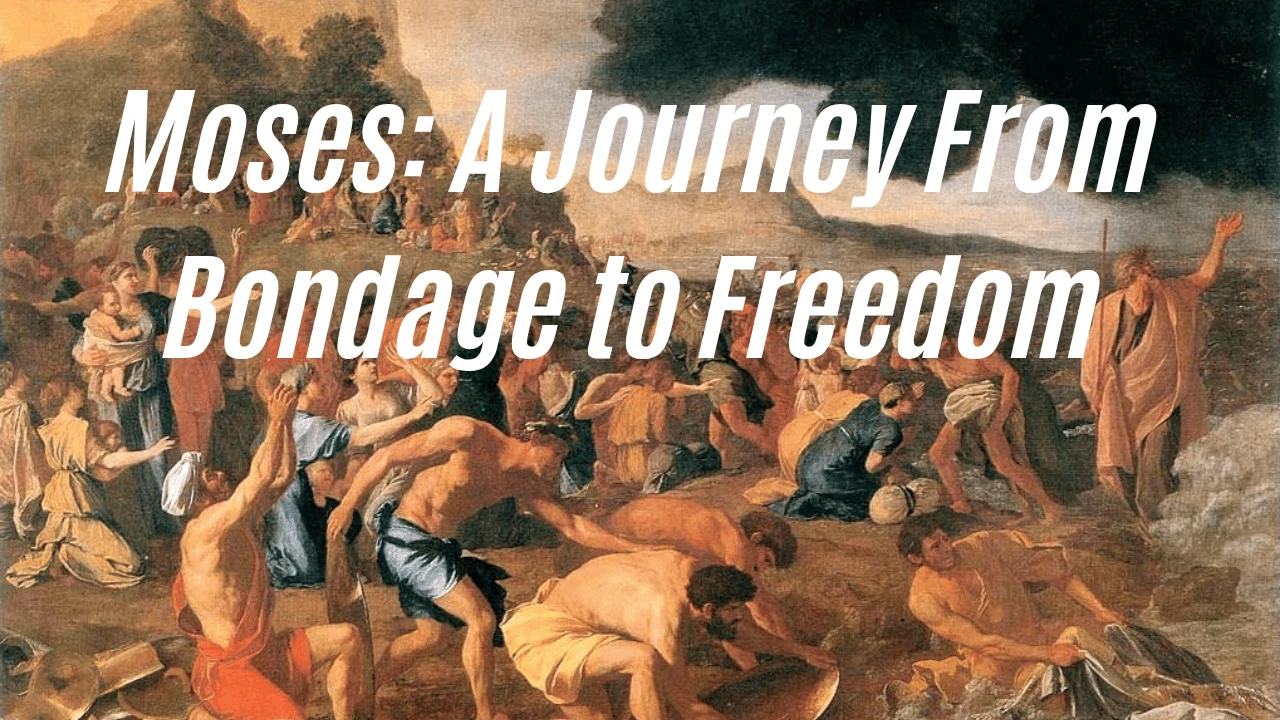
• God prepares us in the wilderness: Saved from death as a baby and raised in Egypt’s royalty, Moses fled to the desert of Midian after attempting to force deliverance in his own strength. In the quiet of the wilderness, God transformed a proud prince into a humble shepherd, proving that God's timing and character development always precede His calling.
• God’s strength is perfect in weakness: At the burning bush, Moses made excuses about his inadequacies. Yet, God’s response was simple: "I will be with you."
• God's Faithfulness outlasts the struggle: Moses faithfully led a stubborn, wandering nation, anchoring his soul in deep intimacy with God. Though his own human frustration kept him from entering the physical Promised Land, his true reward was the face-to-face relationship he shared with the Creator.
Moses’ legacy reminds us that God does not call the equipped; He equips the called.