Series: Moses: A Journey From Bondage to Freedom
Moses and God's Exodus
September 06, 2026 | Peter Rowan
Passage: Exodus 2:1-23
Summary
Does God see what you are going through? The opening chapters of Exodus walk straight into that question through slavery, desperation, and tears. Before Moses is even born, God is already at work, multiplying His people just as He promised in Genesis. When suffering intensifies under a new Pharaoh, God works through unlikely people, including midwives, a grieving mother, and a princess, to preserve life and move His plan forward. After chapters of pain and oppression, the story lands on two words that change everything: God saw and God knew. He is not distant or unaware. He sees, He knows, and He acts. And in Christ, He has acted definitively, securing a greater Exodus from sin and death for all who trust in Him.
Transcript
Let's pray again, Lord, as we turn to the book of Exodus. We pray your blessing upon us, God, that we would journey with you not just in these stories long ago, but in our own stories, in our individual lives and lives, our community. That the long journey of faith would be one not of a distant story, but of one of our story. God, that we would delight in the ways that you've worked with your people. But more so than that, that we would delight in the way of Christ, who brings us through our own Exodus, through the cross resurrection.
Would we delight? Would we glory in you from having spent this time together in Jesus name? Amen. All right, you can open up your Bibles there to the Exodus passage. We're going to be starting a series in the book of Exodus for the fall.
If you've been around for a number of years, you know that in the fall we kind of alternate between New Testament and Old Testament. And this year we're going to be in Exodus, primarily looking at the life of Moses. But of course, it won't just be about the life of Moses. The stories that are often centered on the life of Moses, of course, also are really encompassing the story of Israel. And they're not just about the life of Moses or the story of Israel.
Actually, most of the time they're about God and his great work and what he does for his people, both individually and collectively. We're going to consider questions like what does God do in the midst of our suffering? What does he do with our doubt? What does he do with our inability and our small faith, our inadequacies? What does he do with our need?
What does he do with our sin? What does he do with our failures?
And yet, as you turn to the book of Exodus, what you do find out pretty quickly is that this book really is often focused on this large figure, Moses, this large individual. And so I think it makes a lot of sense that we would maybe consider most of the narrative texts of Exodus through the life of Moses as a sort of a directing way for us to take on the narrative texts of Exodus. He is. So I read this a couple weeks back, one author saying that outside of Jesus, Moses is the most influential figure ever in church. Sorry, not church history, in history, global history.
Outside of Jesus, Moses is the figure. I wonder what you might think of that. Maybe, kind of maybe think of some others. But think of this. At least all of the great monotheistic religions, Christianity, Judaism, Islam, they all find their beginning, at least with the writings of Moses.
Think about this. The New Testament Mentions Moses by name some 80 times. Refers to him. Well, actually, a few more than that. That is more than Abraham.
That's more than David. It is second only to Jesus. I mean, even the gospel passage from Luke, right?
Luke doesn't say in beginning with the law and going through the prophets and the historical books, he interpreted to them all the things concerning himself. He says, beginning with Moses. Right. He mentions Moses specifically to refer to the texts that Moses wrote. So he's this huge, large individual that in some ways his life is mirroring some of the life of Israel.
Sometimes it's leading it. There'll be stories that have to do with leadership and things like that and, of course, redemption and all these other questions I've mentioned. But as we think of influential individuals, it's hard not to think, for me, this past week of influential individuals. That's hard to say together, influential individuals who've passed away recently. At the end of July, the Irish singer songwriter Glenn Hansard died.
Maybe you're familiar with him. I was pretty familiar with his work. He was the lead guy for the frames. He was in the movie once. Maybe some of y' all saw that.
And then actually this little duo kind of spun off of that. The Swell Season with Marketa Iglova. His funeral packed St. Patrick's Cathedral there in Dublin, and actually it spilled out into all the streets. If you saw videos, like, the streets were just full of people singing his songs and mourning his passing. Because he was an Irish emblem in a way.
He actually called himself a dove, which was to say, I'm a man, he's a part of the people. He may have great fame, like winning an Oscar and all this, but he was part of the Irish people. He sang their songs in their pubs, and they sang his songs in their streets. And so at his funeral, Bono sang. Other great Irish figures were there, leading politicians, particularly great musicians.
And also Eddie Vedder, who is not Irish, but thankfully comes from the great state of Washington. Right. Eddie Vedder and Marketa Iglova sang one of Hansard's songs. And the name of that song was A Song of Good Hope. Let me read the first stanza.
If we're going to make it cross this river of lot, cross this river alive. You need to think like a boat and go with the tide. And I know where you've been has really left you in doubt of ever finding a harbor, of figuring this out. And I love that. That imagery evokes Ireland in a way, but it also evokes, like, the long struggle of life, like the Long journey of going.
Where's the hope here? Where am I going? And yet it is titled Write a Song of Good Hope. Of course, Dolly Parton also passed away a couple weeks ago, just shy of a couple weeks ago. And you might have listened to her music, you might not have.
But as I mentioned, as I was refer to the words of forgiveness and peace from 2 Corinthians. If you had an image of Dolly Parton, it was probably one of her smiling. I mean, she just smiled, like, all the time. I mentioned this podcast that a friend kind of mentioned where these guys at the end of the podcast are sort of reflecting on Dolly Parton, and they said that she really did just cut through all the bipartisan stuff, right? People would try to catch her in something, and it seemed like she zigged when they zagged, and zagged when they zigged and just wouldn't take it.
And she was in, like I said on this sort of joke, that there was a joy that existed beyond the reality of all of our infighting. And I think part of the appeal of Dolly Parton was not just her smile, but the fact that most of us knew that she came from the mountains of East Tennessee, and most of us had a sense of her story. She was the fourth of 12 children. She was raised in a cabin without running water and without electricity. Her father was a sharecropper and actually paid the doctor who delivered her with a sack of cornmeal.
In some ways, she embodied sort of the American dream, made reality, but knew suffering and had this deep sense that there was something beyond it. And, of course, this past week, Wendell Berry died on Monday, who is undoubtedly one of the great writers of our time. I spent a good deal of Tuesday morning crying, reading over his poems and one of his short stories. I did an independent study in seminary on Wendell Berry's writings in the Port Williams series. I can say without a doubt that I had never cried as much reading a novel until I read his book, Hannah Coulter, which I hope many of you have read.
But if you've read him, I think the thing that permeates his writing is this attentiveness to the world, which means that he's attentive to the real tragedy of the world, the sorrow of the world, particularly the natural world. But also there's this odd. There's a grief that's there that is also tinged with a hope. And he has this in his poems and his essays, his short stories, his novels, which is to say that these people are all telling a story. And they're telling a story that is true to the world.
Each one of these characters is telling a story that's true to the world. The story of Ireland and its oppression, one of poverty and joy, one of attention and grief. And it sort of begs the question, like, what stories are we telling each other? Right? What stories are we listening to?
What stories are we reciting and singing about?
And if there is one story in the Old Testament that marked the Old Testament saints, the Old Testament people of God, the one story that they were supposed to tell again and again. Actually, just a couple weeks ago, Jess mentioned when we were looking at the Psalms, she said, again, there's another psalm talking about the Exodus, another song that recounts the story coming out of slavery and oppression and hardship and ruthless burdens, the story of Moses. Because, of course, the story of Moses isn't just about Moses. This story about God giving a true account of this world, seeing and knowing and acting, working through his people, hearing their suffering, cries and coming to their rescue. And so it's a story that was told again and again and again.
You know, I've seen some videos the last couple months. Some of them I watched a number of times of Glen Hansard in pubs singing the Irish songs. And then after his passing of the streets filled, singing his songs. And of course, in my own week, I spent some time with Wendell Berry. And of course, I would imagine many of you spent some time with Dolly Parton.
And why do we do this? Because they're giving this account of the world, not shirking off any of the hardship of it, any of the bitterness of it or the suffering, and yet in a way, giving us hope in the midst of it.
So as we ourselves continue in the struggle and continue in the mourning and the grief, part of what I want you to see is that you continue with the journey of God and that God knows and that God sees. So we turn to Moses. We turn to Moses. Hopefully you have it open there. Exodus, chapter two.
And the first thing we read, verse one. Now, a man from the house of Levi went and took as his wife a Levite woman. Seems like a strange way to begin a story about Moses. It seems like really wants you to know that these are Levites. Okay, interesting enough, this is to say that he was born into a family with a mother and father that were not only to lead God's people in worship, that was the role of the Levites, but they were also called to call the people collectively to remember what God has done, to worship him.
Because what he has done to lead God's people back to himself. It's almost giving us a little glimpse, even in that detail of what Moses might become.
And it's a hopeful thing, right? Oh, man. There's these faithful people there that are lead God's people to call them back to themselves. Something good is happening. And if you go back actually to the beginning of chapter one, not the very beginning, but in verse seven, what we read there in verse seven, but the people of Israel were fruitful and increased greatly.
They multiplied and grew exceedingly strong so that the land was filled with them. Well, the last time we had those words all together increased, multiplied, and filled was all the way back in Genesis, at the end of chapter one, when God blesses them and says, increase, be fruitful, multiply and fill the earth. It's almost as though, again, right at the beginning of this story, there's this hope, there's a sense of man, what God had said he would do, he's accomplishing the work is happening in the world and through God's people.
And when. What's the next thing we learn about Moses, we turn back to chapter two.
The woman conceived and bore a son, and what she saw. And when she saw that he was a fine child, she hid him. She hid him three months, actually. Then it goes on to say, right, that she. She hides him until she could hide him no longer.
Which is to say that, you know, he grew up like most people did. He became bigger, sort of like the Israelites are becoming bigger, and he's gaining a voice and he's gaining a presence in the world. And for him, that might mean death. So if we looked back at chapter one, of course, we could hear, read about how Pharaoh, Pharaoh came to power, who did not know Joseph. And he looked out and he saw, oh, they're increasing, they're growing.
It says they're becoming too many and too mighty. They're too much, too much for the Egyptians. And in some ways, like Moses was too big to hide. The Moses was hidden, of course, because Pharaoh decides that he must set taskmasters over them, to afflict them with heavy burdens. Verse 11 of chapter one tells us.
And actually, if we just kind of walk through parts of chapter one, the words that you would hear repeated again and again are words like this. They were oppressed. They were treated ruthlessly. They were slaves. Their lives were bitter.
They were under hard service. And again then at the end of that section, it says they ruthlessly made them work as slaves. So for all the like hope that you have, oh, the world might be coming into what God had called it to be fruitful, multiplying. Filling what you have is suffering and grief and sorrow upon sorrow. A life where a mother must take a basket, their child bitter, ruthless, oppressed slaves, hard service, ruthless slaves, again and again suffering.
And my guess is that in this kind of scenario, in this kind of setting, the underlying question that may be coming up again and again is, where is God?
Right? I mean, finally, Abraham's promise that he would be made into a great nation has come about. And it seems as though even in their coming about, they're reflecting what God had called them to be there. In Genesis, chapter one, where's God?
Does he see? Does he know that a mother can delight in her little child for a little while and then have to put him in a basket?
Of course, this bitter suffering gets to the point in chapter one, in the next paragraph, beginning in verse 15, that Pharaoh calls the Hebrew midwives to him, and he says, hey, when you're helping the Hebrews and it's boy, you got to kill that baby boy, we cannot have any more of them.
And just actually, as a quick aside, those two midwives are named in this text Shiprah and Puah. And we have no idea who this Pharaoh is, meaning millions, literally billions and billions of people have read their names, dignified their work, and we don't know who Pharaoh is. Lovely little detail. I'm going to get back to them. But they lie to Pharaoh.
And Pharaoh commands all of his people. His people, Every son that is born to the Hebrews you shall cast into the Nile. Throw them into the river, drown them.
So upon their suffering, upon the hard burdens that they're carrying, right upon all that has happened to them now, take their babies and throw them into the Nile.
And this is why this Levite woman, Moses, Mother, who we later learned to be Jacobed, she takes a basket that's made out of reeds, and she dabs it with bitumen and with. With pitch, and she walks. She. She must have carried her child, maybe in the basket, maybe with his sisters right next to him, walks him down to the river to put him in the river to never see him again.
Can you imagine doing that?
Can you imagine that the state of your people and the fate of your child was so dire that you actually had to take a basket and make sure it was waterproof to some degree so that your child might possibly live, might not sink? I mean, picture with me how many tears were mixed with that bitumen in that pitch. Countless tears, I guess. She had to dab that over and over again. That's not some passing act.
Can you imagine the desperation of a woman performing this act? And also to a degree, can you imagine her faith? There's something going on here. There's some degree to which she's saying God's at work. Her tears were no doubt mixed to some degree with wonder what might happen.
Maybe you can think back in your life the last time you shed tears of such a nature.
What we're introduced with here at the beginning of Exodus is really. It really is one of the great questions surrounding the world and certainly surrounding the idea of God, right? I mean, the idea of suffering and the idea of, does God know about this? Does he care about this? Does he see any of it?
And it's a suffering that is not foreign to your experience. I'm sure it's not.
Of course, it's the suffering that the Irish have experienced. Some of, you know, their long stories. And it's the suffering that people in Appalachia have experienced. And actually, Romans 8 tells us that creation itself, right? Think of Wendell Berry's love for creation.
Creation itself is groaning, but so are you.
Some of you have quite literally lost children. Miscarriage after miscarriage. Or the house that we bought actually on Green street, the mother sold it to us because her daughter and her son died before she did.
Some of your kids are just far off relationally and geographically, and that's the cause for your sorrow. We probably haven't actually experienced slave masters, though countless Christians have through the ages. And it begs the same question. It's the same world we are in.
For so many of you, your tears have flown out of the experience of your wandering in the world. Like, just wondering, where am I? What am I doing?
Why am I single? Why am I divorced? Why do I feel so alone?
Why does my sin persist when I fought it for so long? Why have friendships been so hard to cultivate?
Who are my people? And actually, Moses seems to have this experience a little bit, too. In chapter two, like, if we keep reading, this is kind of Moses's experience. There's that, you know, little middle part there in chapter two, the story that you probably know of Moses killing an Egyptian, verse 11, right?
When Moses grown up, he went out to his people and looked upon their burdens, and he saw an Egyptian beating a Hebrew, one of his people. Now, if you see that there's actually a number there, and if you look down, it says one of his brothers. But it's twice said, these are his people. And he Goes out and he. And he strikes this Egyptian down and he buries him in the sand.
He kills them. And what happens after that, of course, is that he goes back the next day and there's two guys fighting, two Hebrew guys fighting. And they say, who made you prince and judge over us? Did you mean to kill me as you killed the Egyptian? Then Pharaoh hears about it and he flees, which is to say at the end of that chapter, he's experiencing the sorrow that so many of us have because he does not have a people.
Right? I mean, that's how it begins. His people. His people. And they're like, we don't want you.
Ferris says, I don't want you. Leave.
The last time, the last person I was with. Sorry, the last grown man I was with who shed tears in my presence was Cyprian, who is the pastor of the Kenya Rwandan Fellowship that meets here on Sunday afternoons. I was meeting with him and some of their other leaders a little over a month ago, and he moved to Ohio. He was here in this place that wasn't even necessarily his home, but he'd made something of a home of it. He had a fellowship of Christians he could be with.
And the lack of employment opportunities here and all invited him sort of to leave and to go to a place that had more Kenya Rwandan speakers in Ohio. But he was, of course, sorrowful, of course, wondering yet again in his life, where am I? Who are my people? And again, we're faced with suffering because that question is so often the question that we deal with. So what's the answer?
What do we do with this? What do we do with these kinds of stories where a mother has to take a reed basket and dab it, so maybe her baby won't drown, or Moses has to flee because he's not here and he's not there and he doesn't know where he is.
Or Cyprian or you or I, what do we do with it? What are the answers for such a world filled as it is with suffering like this? Because you can't escape it. You can't brush it off as though it's not there. So what do you do with that?
And what do you do with the idea of God? Well, of course, one of the answers to do what many people do is they say, well, God can't exist in this kind of world. In this kind of scenario, he doesn't exist. It's a big lie.
The problem with that is that it's still there. It just is what it is. Why are you so upset about it, there's no hope. It's just the way the world is. Get on with it.
Another answer that some people give is that God exists, but he's not really in control, which is to say we can't hold him at fault. You know, some things God gets and some things God doesn't get. And you know, don't get mad at him. He exists, but he doesn't really have much say.
And then I think there's the answer that the story of the Bible gives, which we hear really loudly actually, at the end of Genesis, the very previous chapter, chapter 50, verse 20, where it says Joseph is talking to his, his own brothers who sold him into slavery down in Egypt. What you meant for evil, God meant for good, which is not necessarily answering all the questions you might have. But there is a mysterious reality, a divine dynamic beyond our understand.
And I don't know, actually, I don't believe that it answers most of our questions, but I don't really know of a better answer. I certainly don't think it's a better answer to say, well, God doesn't exist, it's just the way the world is. Get on with it. What are you crying about? I certainly don't think it makes sense to say, well, God doesn't really have much say.
Now Joseph's statement there, what you meant for evil, God meant for good is the story of Moses and it's the story of Jesus, and somehow it's the story of your life. The people of Israel think with me of this story of Moses. Because in this story, where there is so much evil, where there's so much suffering, where no doubt there were so many times where God's people in some ways rightly said, God, where are you? Right. Their cries could come up to him, which is a great question for you are your cries and your tears Godward, are they directed towards God?
But think of some, some of the details of the story and how often it is the case that we see, even in the, in the tragedy of all this, God working things out for the good.
He may have been born into a family that loves him, but he's born into slavery, right?
And yet it does seem that the evil of it all is worked out in mysteriously good ways. And almost always, at least in these stories, it's through looking at the accounts of the women in this story, of which there are many. So follow along with me. Okay. The first woman we have mentioned in Exodus are the midwives.
I mentioned them.
And by the way, they are the first of A number of godly civil disobedience examples in the Bible. This is the first one where there's civil disobedience done and God blesses it. But it's almost done in this kind of joking way. Almost. Did you get this?
I think there's actually a little bit of humor that's intended here. The midwives, the nobody midwives of the Hebrews who are mentioned by name, go to the great Pharaoh, the king over Egypt, maybe the strongest person living in the world at the time. And they say this. The Hebrew women aren't like the Egyptian women, for they're vigorous and give birth before the midwife comes to them.
And with such a statement, they pull the wool over his eyes.
With that farce, they get away with it.
God deals well with the midwives, and the people multiply and grow stronger. That's what it says. Divine humor.
Think of Pharaoh's daughter. Think about this, okay? Pharaoh instructed all his people. That's what it said at the end of verse one. Or, sorry, at the end of chapter one.
Right.
Then Pharaoh, verse 22. Then Pharaoh commanded all his people, Every son that's born to the Hebrews you shall cast into the Nile, but you shall let every daughter live. All his people. That's what it says.
His own daughter. His own daughter finds the basket with Moses, and the first thing that she notices is that he's a Hebrew, almost certainly because he was circumcised. He has faithful parents that are following the covenant.
Divine irony. Divine irony. Think of Moses, mother and sisters. The sisters are there watching from a distance. And it must have been actually a pretty good distance because it mentions that Pharaoh's daughter and her handmaidens were there.
You know, there were a bunch of people there. And they're probably watching from a distance, but they're watching from a distance. And can you imagine this? I mean, imagine I have beautiful pictures of Lily holding her younger brothers. These sisters probably doted on him until he got too big and too loud.
And I guarantee you, they were filled with tears as their mother carried that basket down to the the river.
And they're probably there watching from a distance, wondering, are we going to have to jump in the water? Is some animal of prey going to get that basket? They're probably watching as Pharaoh's daughter, Pharaoh, instructed all of his people to kill, to throw into the Nile any Hebrew boy. They're probably watching attentively. Is this going to be the time where we have to risk our life?
Because that basket is just going to be overturned.
And what happens to them?
They go down and say, hey, we know a nurse.
We know a nurse who would tend to this child. And she responds, go, go get her. Divine protection. Of course, Moses mother, for all of her worry, understandable worry, for all of her understandable tears, which not out there were many.
His mother gets to raise him, being par paid by Pharaoh's coffers, divine provision and Ra's daughters. Ra's daughters live as so many women do, in fear of predatory men. They're going about their daily work, they're harassed by men, shepherds seems to be the norm. Sad and familiar story. But it's in that place that Moses comes and Rael is like, surprised.
How'd you do it so quickly? I'm so used to a bad scenario, a bad story.
But then one of them, Zipporah, becomes Moses wife and gives birth to his son, Gershom, divine shelter.
What I'm saying is that when we look at these women, the midwives and Pharaoh's daughter and Moses sister and Moses mother and Raul's daughter is exactly what we hear of from Joseph's mouth. What you meant for evil, God meant for good.
What you meant for evil, God meant for good. And it's just no wonder that this story, that this story of all stories was the story that was to be told again and again and again. That when God's people gathered together yearly around the feasts of Passover, or when they went up to sing the songs of the Psalter, what would they sing again and again and again, these stories, right? This story of redemption, this is the thing that would mark them, that they would just tell one another again and again and again would nourish them in their faith, wondering, does God see and does God know?
Does he know my tears? Does he know my pain? Does he know my trouble?
Of course, this is the very story that Jesus and his disciples are recounting on that last Passover meal that he'd share with them right before he goes to the cross. This was the story of redemption that Jesus was retelling with his disciples. When he says, there's even a greater story of redemption. There's even a greater Exodus, there's a greater slavery, and there's a greater hope that he goes to take care of on the cross in his own suffering and the empty tomb for our hope, God's own exodus, his going out, right? And him himself experiencing suffering and pain on the cross.
You see, we're always telling stories. We are. We're always telling stories to make sense of the World and our place in it. But for Christians in the old epoch, this was the story. For Christians now, the cross and the resurrection is the story.
And what does the cross and resurrection say? But God sees, right? God knows. God acts.
That the effects of Satan, sin and death in the world will not have the final say. That the light shines in the darkness of this world and the darkness will not overcome it.
Did you. I hope you heard this when it was read. But this whole introduction, these first couple chapters that are this great introduction to Moses and to the plight of Israel this whole section ends with these words. Verse 25. God saw the people of Israel and God knew.
And it is that same good news that is mentioned, those verses is absolutely the good news today. God sees, God knows, God acts.
Nothing is lost on him. He's working these things together in ways that are beyond us. But he sees, he knows. I mean, I think part of the draw to kind of get back to the beginning of artists, great artists, great musicians, great writers, great painters is they look, they seek to give a true account of the world.
Don't brush off the suffering and the pain and the grief and the tears, all of that. They don't brush that off. But to give a true account of the world is also to give, like Glenn Hansard's song, a song of good hope.
To give a true account of the world is to say there's something beyond this that our hearts and our bodies ache for.
In our family and in my family growing up, one of the great stories that we would tell are the stories of Narnia. I think many of you probably tell those stories too. And you'll remember, maybe, if you know the stories well enough that in the beginning of the book, Prince Caspian. Prince Caspian is living with his uncle Miraz, who's evil. And the Ptolemy have.
Have sought to put away with the old stories of Narnia to do away with them, to erase them from memory, to no longer tell those stories. And in the great fortune, maybe the divine fortune of Prince Caspian Dr. Cornelius is hired to be his tutor. And of course, Dr. Cornelius is of the old ways. And he says, listen, all you heard about old Narnia is true. All of it's true.
And he had to tell those stories again and again. And that's why we do what we do every week, week in, week out. We tell the story again and again. It's true, it's true. Though our sin is great God's mercy is greater Though our suffering Darkness may last Our sorrow may last for the night joy will come in the morning.
We tell the story of Moses. We tell the story of the Exodus again and again. We tell the story of Jesus again and again and again. And we sing the story of Jesus again and again and again. Because this is our great hope.
This is the hope of the world. God sees, God knows, God acts in his mysterious ways, but certainly definitively.
We rehearse the story of our Exodus. We remember that though we grieve and we suffer and we sin, that Jesus really did come, that Jesus really did die, that he rose again, that light shines in the darkness, the darkness is not going to overcome it. We pray, Lord, thank you for your word. Thank you for the story of Moses. Would we hide it in our hearts?
We see this is the story of our lives as well, and of your love for us, a God who sees and knows. Amen.
Series Information
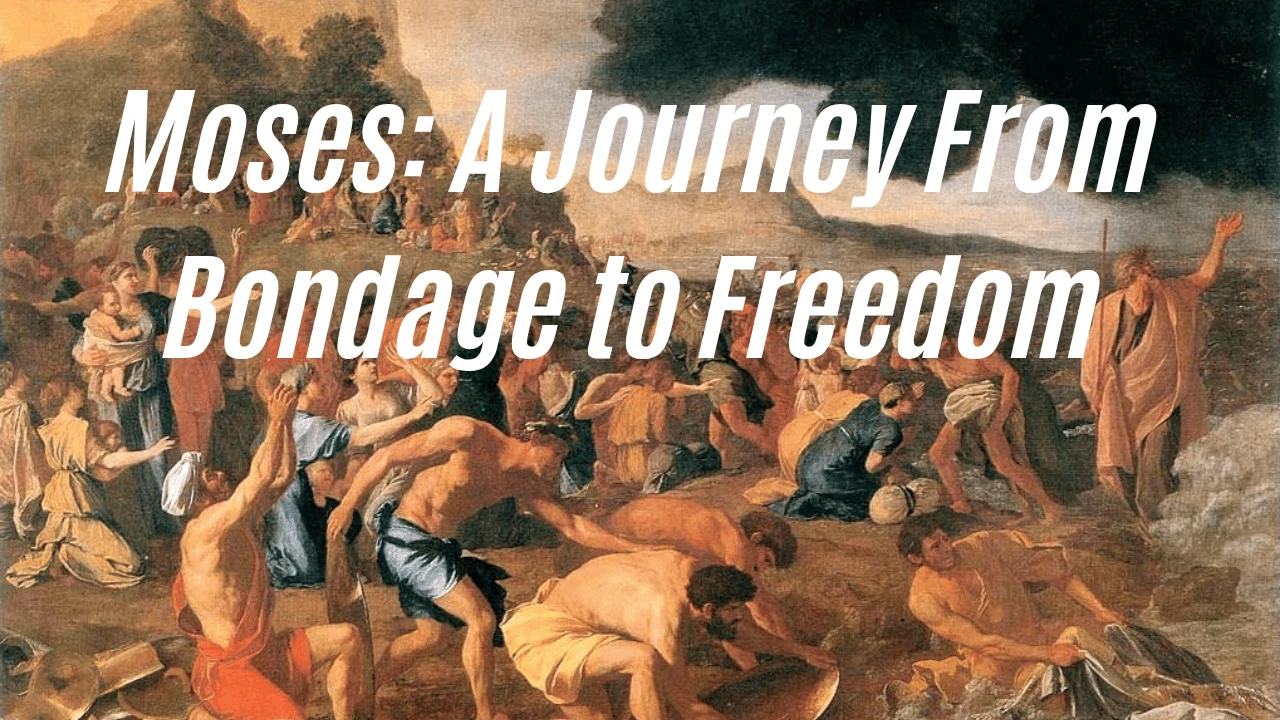
• God prepares us in the wilderness: Saved from death as a baby and raised in Egypt’s royalty, Moses fled to the desert of Midian after attempting to force deliverance in his own strength. In the quiet of the wilderness, God transformed a proud prince into a humble shepherd, proving that God's timing and character development always precede His calling.
• God’s strength is perfect in weakness: At the burning bush, Moses made excuses about his inadequacies. Yet, God’s response was simple: "I will be with you."
• God's Faithfulness outlasts the struggle: Moses faithfully led a stubborn, wandering nation, anchoring his soul in deep intimacy with God. Though his own human frustration kept him from entering the physical Promised Land, his true reward was the face-to-face relationship he shared with the Creator.
Moses’ legacy reminds us that God does not call the equipped; He equips the called.